
How to Turn Your Kids’ Complaints into Gratitude (You can start today!)
* Sometimes I include affiliate links in my blog posts. That simply means I may earn a small commission (at no extra cost to you). I only recommend what I genuinely use or would share with a friend.
“This is boring.”
“That’s not fair.”
“Why do I have to?”
“I don’t like this.”
If you’re a mom, you’ve heard some version of these words more times than you can count. Complaining is almost a childhood language.
And while it can feel frustrating (and exhausting), it’s also a powerful teaching opportunity. By being intentional, you can help your children complain less often.
The goal isn’t to eliminate complaints entirely, but to gently guide your child from automatic dissatisfaction toward contentment.
And that’s where gratitude comes in.
Why kids complain (and why it’s normal)
Before we jump into solutions, it helps to understand what’s happening beneath the surface. Often, children complain because:
They're still learning to identify their feelings [paid link]
Their emotional regulation skills are still developing
They want control in situations where they don’t have much
They feel disappointment strongly
They’re learning how to process frustration out loud
Complaining isn’t always about entitlement. Sometimes, it’s just immaturity. So, when we treat it as a teachable moment instead of a character flaw, it leads to growth and a change in mindset.
We’re raising kids in a culture that constantly promotes excess, so it’s no surprise when dissatisfaction shows up. And the constant barrage of negativity, anger, and frustration that comes from news and social media can leave us with heavy feelings of sadness and anxiety ondaily basis.
If we're feeling it, there’s no doubt our kids are feeling it too. That’s why gratitude matters more than ever for families.
The good news is gratitude can be taught — gently and consistently.
While it’s definitely okay to feel the negative feelings when the world around us seems chaotic, we don’t have to dwell on them constantly. Often, we can make a choice to focus on the good and live a more positive life.
The Gratitude Reframe Method
Here’s a simple three-step approach you can use in the moment your kids start complaining.
Step 1: Validate their feelings
Instead of immediately correcting, start by listening and responding with an acknowledgement like:
“I hear you.”
“That sounds frustrating.”
“I can see you’re disappointed.”
When you validate your child's feelings, you'll help them feel seen and understood. That opens the door for more positive thoughts to enter.
Step 2: Gently reframe the thought
After acknowledging the feeling, and ask questions like:
“What’s one good thing about this?”
“Is there anything we can still be thankful for?”
“What part of this is working?”
You don't want to simply dismiss the hard part, or sweep it under the rug, but you can help your child see that there is more to the situation… and some of it can be good.
Step 3: Model perspective
If they struggle to answer, model it yourself.
Here are some examples:
“I know it’s raining and that’s disappointing. I’m thankful the rain helps our garden grow.”
“Yeah, I’m sad that our plans with friends got cancelled. I’ll miss them too. But now I get to spend some one-on-one time with you.”
“Oooh. I really didn’t like being sick on the weekend, but it sure was nice to stay home and get some rest.”
Over time, your kids will begin to think this way on their own.
Real-life examples
Let’s walk through a few common scenarios.
Complaining about dinner
“This is gross.”
Instead of:
“You should be grateful.”
Try:
“I know it’s not your favorite. What’s one part of it you do like?”
Keep it calm. Keep it steady. Keep it focused on the situation, and not on your child’s character.
Complaining about chores
“Why do I have to clean my room?”
Try:
“I get that it’s not fun. What’s one good thing about having your own space?”
You can also connect gratitude to responsibility and stewardship by teaching the importance of taking care of the things you've been given.
Complaining about boredom
“There’s nothing to do!”
Instead of fixing it immediately, say:
“That’s frustrating. What’s one thing you’re thankful you could choose to do right now?”
Boredom is often a doorway to creativity — if we don’t rush to eliminate it.
Complaining about fairness
“That’s not fair!”
Fairness is deeply important to kids.
Respond with:
“It feels unfair. What’s something good that came from this situation anyway?”
Again — not dismissing, but stretching perspective.
You could even spend some time chatting about what feels so unfair to your child. Their answer may not be what you expect.
What to avoid
There are a few phrases that often shut down growth instead of encouraging it:
“You should be grateful.”
“Some kids have it worse.”
“Stop complaining.”
These may be true, but they often trigger feelings of guilt and shame instead of encouraging positive reflection.
Gratitude grows best in a place of safety, while guilt can lead to further negativity.
Make it a family practice
If complaints feel constant in your home, consider creating a lighthearted system.
Some ideas:
A “complaint-to-gratitude” jar where you rewrite complaints into thankful statements.
A weekly challenge to find gratitude in one hard situation
A dinner table rhythm of gratitude where everyone shares one frustration and one thankful perspective.
Need more simple ideas to encourage gratitude in your home? Read 10 Easy Gratitude Activities You Can Do at the Dinner Table.
Why this matters long term
When you help your child reframe complaints into gratitude, you are teaching:
Emotional resilience
Taking a wider perspective
Self-awareness
Personal responsibility
Contentment
We're not trying to teach our kids to suppress their feelings. Those feelings are completely valid. And dismissing those feelings — replacing them with false happiness — isn't healthy. It's toxic positivity.
Instead, we want to teach them how to hold two truths at once:
“This is hard," AND "There is still good in this situation."
We want to make space for the sadness, disappointment, frustration, and other feelings that come up. But we want to keep them in perspective and make room for the positive as well. That balance is powerful.
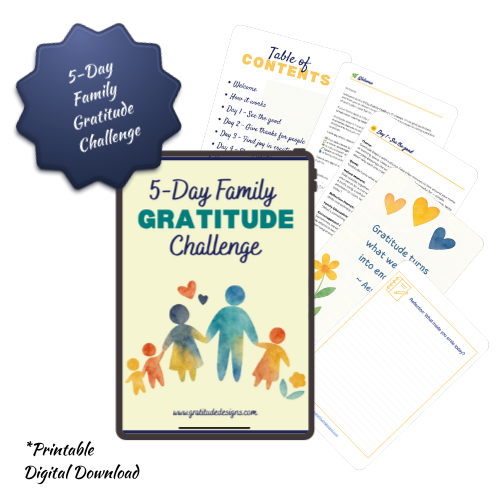
If you want a gentle, doable way to start, you can begin with this free short 5-day family gratitude challenge.