
10 Easy Gratitude Activities You Can Do at the Dinner Table
* Sometimes I include affiliate links in my blog posts. That simply means I may earn a small commission (at no extra cost to you). I only recommend what I genuinely use or would share with a friend.
If your dinner table feels anything like most family tables, it probably isn’t candlelit and peaceful.
It’s noisy.
Someone doesn’t like what’s being served.
Someone else is talking over everyone.
And at least one person forgot to clear their plate.
And yet — this messy, ordinary moment might be one of the most powerful opportunities you have to shape your family culture.
You don’t need elaborate systems or perfectly behaved children to build gratitude. You just need a consistent rhythm.
The dinner table is that rhythm.
Thankfulness and contentment may not happen naturally in today's world, but an attitude of gratitude may be more important than ever for today's families.
It’s a habit that grows intentionally. Since dinner is a simple, built-in anchor point – you’re already gathered around the table – it's a great place to start.
Here are 10 easy, no-prep gratitude activities you can start tonight
1. Rose, Thorn, Bud
Each person shares:
A “rose” (something good from the day)
A “thorn” (something hard)
A “bud” (something they’re looking forward to)
This builds emotional awareness while gently guiding kids to notice good even when the day wasn’t perfect.
For younger kids, simplify to just “one good thing.”
2. High, Low, Grateful
Similar to Rose/Thorn, but end with:
“What’s one thing you’re grateful for today?”
Even on tough days, this question creates a positive perspective without dismissing real feelings.
3. Thankful for Someone at This Table
Each person shares one thing they appreciate about someone sitting there.
This builds connection and reduces sibling tension over time.
You can keep it light:
“I’m thankful you helped me find my shoes.”
Or deeper:
“I’m thankful you try again when things are hard.”
4. The Gratitude Alphabet Game
Choose a letter and go around the table naming something you’re thankful for that starts with that letter.
“A — apples.”
“B — bikes.”
“C — cousins.”
It keeps younger kids engaged and makes gratitude feel playful instead of preachy.
5. One Hard Thing, One Good Thing
This is especially helpful for kids who lean toward complaining – a reframe that can help kids move from a complaining mindset into an attitude of gratitude.
After they share something difficult, gently ask:
“Is there anything good about that situation?”
Not to trivialize their feelings… but to help them stretch their perspective.
Small language shifts make a big difference.
6. Gratitude Jar Pull
Keep a small gratitude jar [paid link] near the table. Throughout the week, family members can write down things they’re thankful for and drop them in anytime.
Once a week or so, take time to read and reflect on them together.
7. What Went Right?
Instead of asking, “How was your day?” try:
“What went right today?”
It shifts the brain from scanning for problems to scanning for positives.
Research consistently shows that what we look for, we find more of. This question trains the gratitude muscle.
8. Thank You Spotlight
Pick one person in your life (teacher, neighbor, coach, grandparent) and talk about why you’re thankful for them.
You can even follow up by writing a quick thank-you note together later.
Gratitude grows (and makes a person's day) when it’s expressed.
9. Gratitude for Something Small
Challenge everyone to name something tiny they’re thankful for.
Warm socks.
Cold water.
A favorite song.
A pet’s slobbery kisses.
This teaches kids that gratitude isn’t reserved for big milestones. It lives in ordinary moments.
10. Tomorrow’s Gratitude Intention
Before leaving the table, ask:
“What’s one thing you’ll look for tomorrow that you can be thankful for?”
This gets kids thinking about gratitude even before good things happen.
How to make this activity sustainable
The goal isn’t to do all 10 activities.
Choose one.
Rotate occasionally.
Keep it short — 2 to 5 minutes is enough.
Don’t force participation. Some kids warm up slowly.
Model it consistently, and over time it becomes normal family language.
Start small. If dinner feels too chaotic every night, try just two evenings a week.
What if my kids resist?
That’s normal.
Gratitude can feel awkward at first, especially if it’s new. Instead of saying, “You should be grateful,” try: “I’m thankful we’re all sitting here together.” Let it start with you. When gratitude becomes part of the emotional atmosphere, resistance usually softens.
Why this small habit matters
The dinner table is one of the few places families naturally gather without screens (or at least, that’s the goal). It’s a built-in moment of connection. When you intentionally anchor gratitude to that moment, you’re building:
Perspective
Empathy
Family unity
And you’re doing it without adding one more item to your to-do list.
No need for perfection… just small, steady shifts. And the dinner table — even on messy nights — is a beautiful place to start.
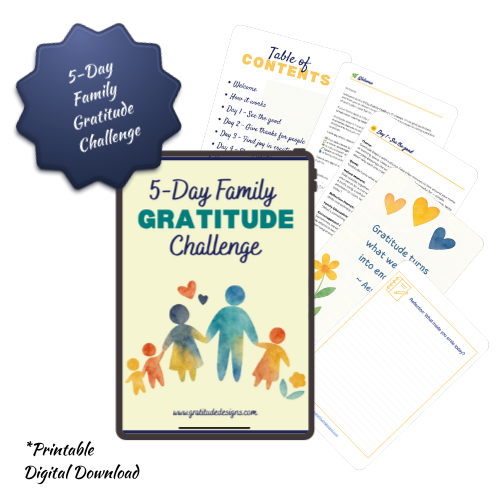
If you’re wanting a little more structure to help you begin thinking about gratitude as a family, I created a simple 5-Day Family Gratitude Challenge you can use to introduce gratitude in a gentle, guided way. It includes daily prompts designed specifically for busy families.