
Why Gratitude Matters More Than Ever for Today’s Families (and How to Start)
* Sometimes I include affiliate links in my blog posts. That simply means I may earn a small commission (at no extra cost to you). I only recommend what I genuinely use or would share with a friend.
It’s easy to feel like gratitude is becoming harder to find.
Many parents today are raising children in a world filled with constant comparison, endless advertising, and the quiet pressure to always want more. Kids are surrounded by messages that say happiness comes from having the newest toy, the coolest clothes, or the latest technology. And if we’re honest, adults aren’t immune to that pressure either.
Not only that, but our world seems to be in a constant state of chaos where negativity, division, and anxiety are at an all-time high.
As a mom, I’ve often wondered whether I’ve done enough to help my kids develop the kind of character that will serve them well in life. Have I taught them to appreciate what they have? Have I modeled contentment? Have I helped them grow into people who notice the good around them?
The good news is that gratitude is something we can intentionally cultivate in our homes. It doesn’t require perfection, elaborate routines, or hours of extra effort. Often, it simply begins with paying attention.
And in a world that constantly tells us to focus on what we lack, what's difficult, what's stressful, what's hard… teaching our families to focus on the good in our lives is more powerful than ever.
Finding Contentment
Today’s children are growing up in a very different environment than many of us experienced.
Between social media, online advertising, and the rapid pace of modern life, kids are exposed to more messages about consumption and comparison than ever before. Even younger children quickly learn to notice what others have, whether that’s toys, vacations, or experiences.
It’s not surprising that many parents feel like they’re constantly hearing things like:
“That’s not fair.”
“I wish we had that.”
“Why can’t I have one too?”
None of this means our kids are ungrateful or spoiled by nature. It simply means they’re growing up in a culture that encourages wanting more.
That’s one of the reasons gratitude matters so much.
Gratitude gently shifts our attention from what we don’t have to what we do… From the negative, to the positive, from worry, to peace. It helps children learn that joy isn’t found in constantly acquiring more things or a different environment, but in noticing the goodness that already exists in their lives. You can help your kids shift their complaining into gratitude.
As author Melody Beattie writes, “Gratitude unlocks the fullness of life. It turns what we have into enough.”
That’s a powerful lesson for children to carry with them.
What gratitude builds in children
Gratitude isn’t just a nice idea or a polite habit. Research has shown that practicing gratitude can have real emotional and psychological benefits for both children and adults.
Children who regularly practice gratitude tend to develop:
1. Stronger emotional resilience
When kids learn to look for what’s good in their lives, they become better equipped to handle disappointment and challenges.
2. Greater empathy for others
Grateful kids are more likely to notice and appreciate the people around them, which helps build compassion and kindness.
3. Increased happiness and contentment
Instead of constantly focusing on what’s missing, gratitude trains the brain to recognize what’s already present.
4. Stronger family connections
When families talk about gratitude together, they create moments of shared reflection and appreciation.
These benefits don’t appear overnight. Like any habit, gratitude grows slowly through small, consistent practices. But over time, those small moments add up in meaningful ways.
Why gratitude starts with parents
If there’s one thing I’ve learned as a parent, it’s that children are always watching.
They notice how we react to frustration. They hear the way we talk about our day. They absorb our attitudes about work, relationships, and life.
That means the most powerful way to teach gratitude isn’t through lectures or reminders.
It’s through modeling.
When we say things like:
“I’m really thankful for this quiet moment.”
“I’m grateful we could spend time together today.”
“Thank you for helping me.”
…our children begin to see gratitude in action.
It becomes part of the emotional atmosphere of the home.
And the beautiful thing about gratitude is that it benefits parents just as much as it benefits kids. Taking a moment to acknowledge something good — even on difficult days — can shift our perspective and bring a little more calm to the chaos of family life.
Small moments that make a big difference
One of the biggest misconceptions about gratitude is that it requires elaborate routines or complicated systems.
In reality, the most meaningful gratitude practices are often the simplest ones.
Here are a few easy ways families can begin cultivating gratitude together:
Be thankful. At the dinner table, invite each family member to share one thing they’re thankful for from the day.
Create a family gratitude jar [paid link]. Write small moments of gratitude on slips of paper, place them in the jar, and read them together at the end of each week
End the day with reflection. Before bedtime, ask your child to name three good things that happened during the day.
Notice the ordinary. Gratitude doesn’t have to be reserved for big events. Sometimes it’s simply appreciating warm meals, laughter, or time together.
These moments may seem small, but they help train children to notice goodness in their everyday lives.
And that skill will serve them long after childhood.
A simple place to start
If you’re like many busy parents, you might love the idea of teaching gratitude but wonder where to begin.
The good news is that you don’t have to figure it out alone.
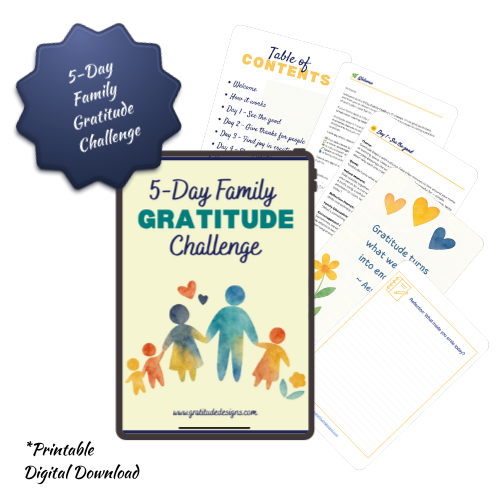
One simple way to start is with a short family gratitude challenge that provides easy prompts and activities designed specifically for parents and kids. Over the course of five days, families can explore simple gratitude practices together — without adding stress or complexity to their routines.
Sometimes the smallest shifts in attention can make the biggest difference.
Gratitude is a gift that lasts
Teaching gratitude to our children isn’t about forcing them to say “thank you” more often or pretending life is always perfect.
It’s about helping them develop the ability to notice the good that already surrounds them.
In a world that constantly pushes us toward dissatisfaction and comparison, gratitude offers something different. It helps families slow down, appreciate the present moment, and find joy in the ordinary parts of life.
And perhaps most importantly, it helps children grow into adults who carry a deep sense of appreciation for the people, opportunities, and blessings they encounter along the way.
That’s a gift that will last far beyond childhood.