
How to Start a Family Gratitude Journal
* Sometimes I include affiliate links in my blog posts. That simply means I may earn a small commission (at no extra cost to you). I only recommend what I genuinely use or would share with a friend.
Many parents want their children to grow up with a sense of appreciation.
We want our kids to recognize the people who help them, notice the good in everyday moments, and develop a perspective that focuses on gratitude — instead of complaining.
But gratitude isn’t something children automatically develop on their own. Like many character traits, it grows through practice. And one of the simplest ways to nurture that habit is by starting a family gratitude journal.
A gratitude journal doesn’t need to be complicated or take a lot of time. In fact, the most effective gratitude routines are usually simple, relaxed, and woven into everyday family life.
Here’s how to start a family gratitude journal in a way that feels natural and meaningful.
Why gratitude journaling works for families
Gratitude journaling has become a popular practice in recent years, but the idea behind it is actually quite simple.
Often we picture moms or teenage girls using gratitude journals, but really, they're great for anyone. And when a family does it together, it offers amazing opportunities for discussion and connection.
When people regularly reflect on the things they are thankful for, they begin to notice positive experiences more often. Researchers studying gratitude have found kids who practice gratitude tend to have:
greater life satisfaction
improved emotional well-being
stronger relationships
a more optimistic outlook
When kids start practicing gratitude early, they gradually develop the habit of noticing the good around them independently, much sooner. Even small reflections can shape how children interpret their daily experiences
What a family gratitude journal looks like
A family gratitude journal doesn’t need to follow strict rules. Some families use a shared gratitude journal. Others allow each family member to have their own notebook. Over the years, we've used printed journals, simple notebooks, and large whiteboards the whole family can write on.
In the movie, Unsung Hero, a family moved to the United States with nothing and came very close to giving up... except the mom refused. She looked for good in every situation, modeling thankfulness for her children constantly. And her kids picked up on it. In one scene that stuck with me, the kids wrote their needs and answered prayers on recipe cards. As they prayed for them, they stuck them on the wall under the simple headings PLEASE and THANK YOU. What a beautiful way for a family to represent their gratitude together.
So, it doesn't matter how you journal your gratitude. What matters most is creating a space where each of your family members can reflect on things they appreciate.
Entries can include things like:
something good that happened during the day
someone who helped them
something that made them smile
a challenge they learned from
Even a few sentences can be meaningful. And if your kids don't write yet? No problem! You or an older sibling can write down what they say.
Choosing a journal
One of the simplest ways to begin journaling together is by choosing a notebook or journal that your family enjoys using.
You might choose:
a simple notebook
a dedicated gratitude journal
a printable gratitude journal
individual journals for each child
or even a digital note on a phone or computer
Younger children may prefer journals with space for drawing, while older children may enjoy writing their reflections.
You could have one journal that's shared by the whole family or individual journals for each child with opportunities to share some of what they’ve written.
The goal is to make the experience feel enjoyable rather than another item to check off your to-do list.
When to practice gratitude journaling
Gratitude journaling works best when it becomes part of a regular family rhythm. Some natural moments to practice include:
Dinner time - Families can share something they are thankful for from the day.
Bedtime - Kids can write or talk about one positive moment before going to sleep.
Weekend reflection - Families can look back on the week and share highlights.
Even a few minutes of reflection can help children begin developing gratitude as a habit.
Simple gratitude prompts to get started
Children sometimes need a little help knowing what to write. Prompts can make gratitude journaling easier and more enjoyable. For example, you might ask:
What made you smile today?
Who helped you today?
What is something you are thankful for about your family?
What is something you learned today?
What is something kind someone did for you?
These prompts help children begin reflecting on their experiences in a positive way.
Keeping gratitude journaling fun for kids
The most important part of gratitude journaling is creating a positive experience. Here are a few simple ways to keep it enjoyable:
Keep it short - Children don’t need to write long entries.
Allow drawing - Younger kids may enjoy drawing pictures of things they appreciate.
Avoid pressure - Some days children may not feel like writing. That’s okay.
Celebrate small moments - Gratitude often grows through everyday experiences.
When journaling feels relaxed and natural, children are more likely to continue the habit.
How gratitude journaling shapes perspective
Over time, gratitude journaling can influence how children see their world. Instead of focusing primarily on what they lack, children begin noticing what they already have. They may start recognizing:
kindness from others
small everyday joys
opportunities to learn and grow
the support of family and friends
and even their own talents and abilities
This shift in perspective can help children develop qualities like empathy, resilience, and appreciation.
Starting small makes a difference
Many families assume gratitude practices need to be elaborate to make an impact. But, in reality, small daily reflections are often the most meaningful. A single sentence written each evening can gradually build a powerful habit of noticing the good in life.
Over time, these small reflections can shape how children approach the world around them.
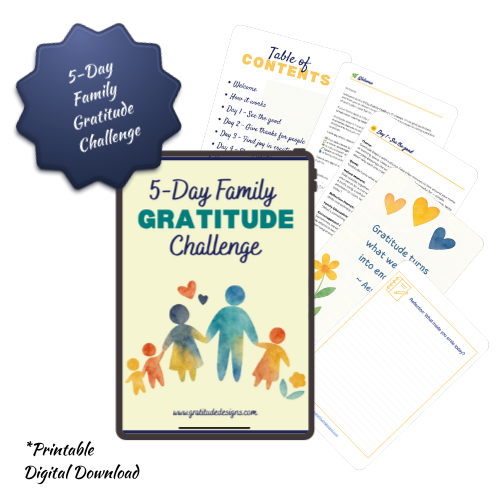
Looking for a gentle, doable way to start practicing gratitude together? Try the free 5-day family gratitude challenge.